
Designing Connection
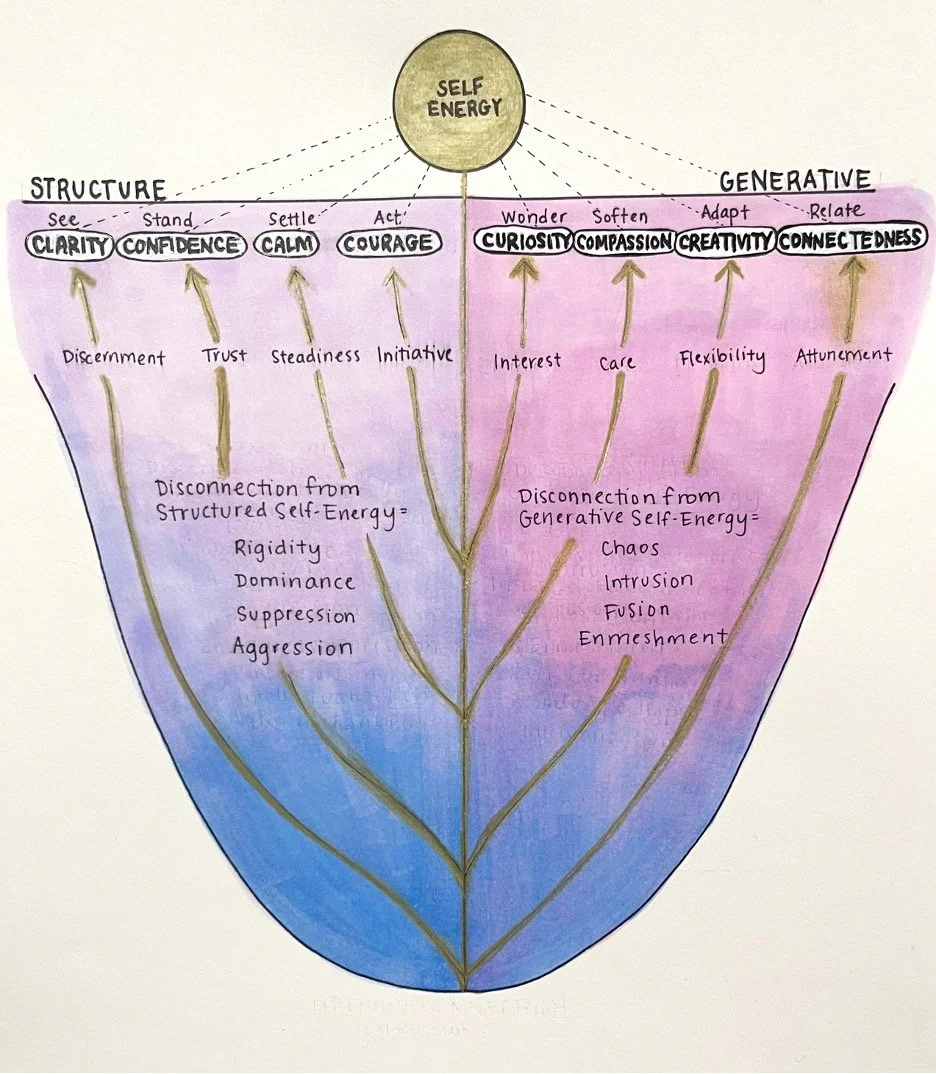
‘Self Energy Spectrum” By Melinda Meyers 2026
Different Protectors, Different Relational Needs
Over time in my clinical work integrating EMDR and IFS under Dr. Kendhal Hart’s model, I noticed that different protectors softened through different relational experiences with Self. Some parts responded almost immediately to warmth, curiosity, compassion, and emotional attunement. Others did not. Some protectors seemed far less interested in reassurance than in consistency. They needed to experience Self as grounded, discerning, steady, and capable over time before trust could develop. These parts were not asking for comfort in the way I initially expected. They were asking for structure.
Hypervigilant Protectors and Shame as Adaptation
I began noticing this most clearly with hypervigilant protectors. Many of these parts seemed to have been carrying responsibility for the system for a very long time. Often, the job itself had become their identity and purpose. Somewhere along the way, they learned that the system could not survive without them maintaining control, vigilance, suppression, or preparedness.
In many ways, these parts reminded me of the shame-as-defense adaptation described in EMDR Toolbox. For a child to fully recognize that a caregiver was unsafe, inconsistent, frightening, rejecting, or incapable would also require confronting something much more overwhelming: helplessness. And helplessness, especially in childhood, can feel intolerable. When I explain this to clients, I often talk about how intensely these protectors experience emotion and threat within the system. To the protector, the emotional stakes often still feel life-or-death. Because in many ways, they once were.
Children are completely dependent on their caregivers for survival. When attachment feels threatened, unsafe, inconsistent, or emotionally unavailable, the nervous system does not experience that as an abstract relational issue. It experiences it as danger.
As adults, we can sometimes forget this.
We imagine children should have simply recognized the environment was unhealthy, protected themselves differently, or walked away. But children do not have the option to simply leave. They cannot move out. They cannot survive independently. They cannot organize safety for themselves. So the system adapts instead.
Then I must become whatever is necessary to preserve the attachment.
More helpful.
More controlled.
More perfect.
Less emotional.
Less needy.
If something is wrong with me, then perhaps something can still be fixed. And if something can still be fixed, then maybe there is still hope for connection, safety, and survival. So a protector forms around preventing contact with helplessness at all costs. The part suppresses vulnerability, dependency, fear, grief, anger, and often even awareness itself in order to preserve functioning and survival.
What I began noticing clinically was that these parts often did not soften simply through reassurance. They softened through recognition. Through finally having someone acknowledge how unfair it was that they had been tasked with carrying responsibilities far too large for them for far too long. And then, often even more importantly, through gratitude. Not gratitude that reinforced the burden, but gratitude that honored the labor.
Many of these protectors seemed deeply shaped around work, responsibility, and functioning. To receive warmth in connection to the role they had carried so faithfully often created profound softening within the system. It was as though the protector no longer needed to fight quite so hard to prove its importance or necessity because, perhaps for the first time, it felt fully seen.
Protectors Without Words
At the same time, I began noticing another category of protectors that organized very differently. These parts often did not initially emerge with a clear narrative, identity, or even words. They appeared more as states than fully formed internal characters. Emotional flooding. Sensations. Atmospheres. Impulses. Somatic activation. Waves of fear, panic, grief, or fusion that did not yet have language attached to them. Often, the words came much later if at all.
At times, it felt as though these parts were disconnected from the organizing and meaning-making processes that would eventually allow them to become fully knowable to the system. Where hyperstructured protectors often organized around function, responsibility, and identity, these parts often appeared disconnected from form itself. They did not need recognition for the work they had done in the same way. They needed help becoming organized enough to emerge safely into awareness.
The bridge here seemed less about gratitude and more about containment, orientation, naming, differentiation, and structure. Not rigid control, but enough steadiness for experience to become tolerable. Enough organization for feeling to become symbolized rather than simply endured. These parts often did not initially need interpretation or insight. They needed help discovering that their emotional world could exist without overwhelming the entire system. They needed boundaries, pacing, grounding, and repeated experiences of Self remaining present in the face of what previously felt unbearable.
Polarization Within Trauma Systems
The more I sat with this clinically, the more I began wondering if many trauma systems organize themselves around polarized regulatory strategies that are often reacting to one another without fully understanding each other’s function. One part may move toward control and hypervigilance. Another toward flooding and overwhelm. One suppresses. Another erupts. One tightens. Another spills outward. And yet, beneath the conflict, both often appear to be attempting to solve the same underlying problem:
Safety.
Control.
Connection.
Survival.
A hypervigilant part may increase rumination or control in an attempt to prevent emotional overwhelm, while another part becomes increasingly emotionally flooded in an attempt to gain expression, release, or connection. Both parts may ultimately contribute to instability while attempting to restore balance. And often, neither part fully understands the other.
The Conference
What has stayed with me most in this work is what happens when these polarized protectors finally become aware of one another. Over time, I began experimenting with something I now often refer to as a conference. Loosely inspired by Fraser’s Dissociative Table Technique, we invite the parts into a shared internal space together. A conference room of sorts. Not to force agreement or eliminate conflict, but simply to allow them to witness one another directly for perhaps the first time. Again and again, I noticed something unexpected happen. Although the protectors often appeared completely opposed in their strategies, underneath the conflict they almost always shared the same fundamental goal:
Protection.
Safety.
Connection.
Survival.
The hypervigilant protector trying to maintain control and the emotionally flooded protector seeking release were often attempting to protect the same system from the same pain through entirely different strategies. And yet, until that moment, they had often never fully understood one another. Sometimes one protector would look at the other with confusion. Sometimes frustration. Sometimes exhaustion. But almost every time, once the parts understood what the other had been trying to carry, something softened in the system.
The protectors no longer experienced themselves as enemies competing for control. They began recognizing themselves as teammates. As complementary. As protectors carrying different pieces of the same story. What emerged was not necessarily the elimination of either protector, but a growing capacity for collaboration, flexibility, and shared leadership within the system itself.
Organizing the Spectrum of Self-Energy
Over time, I began informally organizing these observations through the 8 C’s of IFS. Certain qualities of Self-energy seemed more structured in nature, while others felt more generative and relational.
On the structured side, I began placing qualities such as:
calm
clarity
confidence
courage
These qualities seemed connected to grounded leadership, discernment, steadiness, and containment.
On the generative side, I began placing:
curiosity
compassion
creativity
connectedness
These qualities felt more relational, adaptive, emotionally responsive, and oriented toward openness and attunement. The image itself is less important to me than what it began helping me notice clinically. Protectors disconnected from structured Self-energy often initially presented as rigid, controlling, aggressive, or suppressive. Many of these parts seemed to soften through relationship. Through warmth. Through emotional attunement. Through experiencing something different from the environments they may have originally adapted within.
In contrast, protectors disconnected from generative Self-energy often appeared emotionally flooded, fused, chaotic, or intrusive. Interestingly, these parts often did not primarily require more emotional openness in order to regulate. They seemed to require structure from Self: consistency, discernment, boundaries, steadiness, and trust that their emotional world could be held without collapse or abandonment.
Closing Reflections
The more I observed this, the more I began wondering if healing sometimes involves helping polarized systems experience different forms of relationship with Self depending on what those protectors most fundamentally need. Some parts soften through compassion. Others soften through consistency. Some need recognition. Others need organization. Some need permission to feel. Others need trust that feeling can be survived.
This is still a developing framework and not something I experience as fixed or complete. It is simply an attempt to put language to patterns I continue to encounter in trauma work. What continues to stay with me most is the possibility that many systems are not organized around pathology as much as adaptation. Protectors are often attempting, desperately and faithfully, to restore balance in the only ways they know how. And perhaps healing is not about eliminating those strategies, but helping the system discover that structure and connection were never meant to exist in opposition to one another, but instead have the capacity to be complementary.
